What are the design considerations for the height of a forklift's gantry and lift?
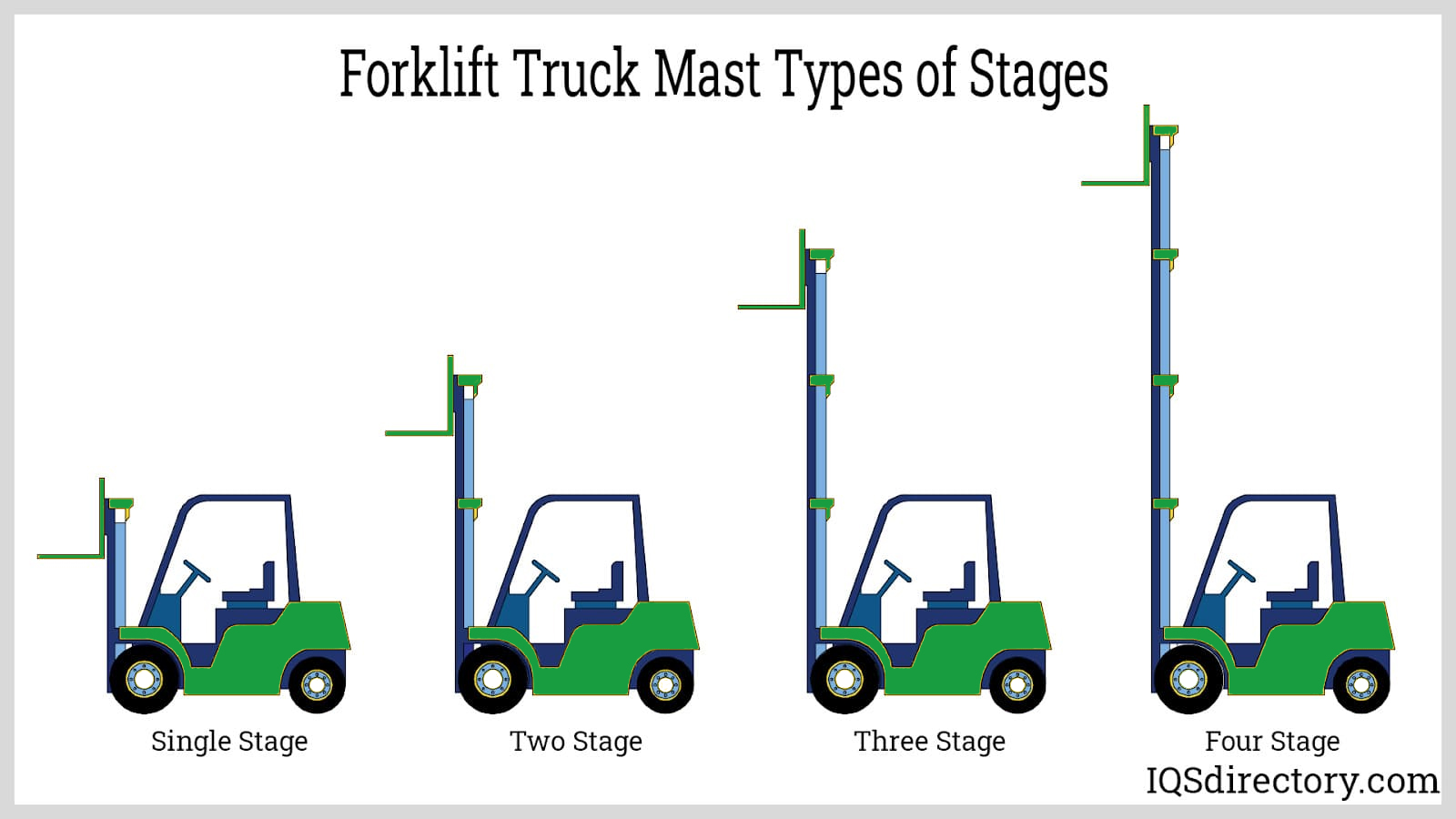
Overview of forklift mast design:
Forklift trucks are equipped with a critical component, the mast, which supports the lifting mechanism and controls the vertical movement of the forks or attachments. The design and type of mast play a key role in determining the functionality and suitability of a forklift truck for various tasks.
Types of forklift masts:
Single-stage (single-worker) mast:
This mast type has only one telescopic section and is usually used with low lifting height. It is approximately between 2 and 3 meters.
Dual-stage (duplex) mast:
Duplex masts include two telescoping sections, providing a higher lifting capacity than single masts, and are used for medium heights. Lifting heights are typically around 3 meters to 4.5 meters.
Three-Stage (Triplex) Mast:
Triplex masts have three telescoping sections to provide greater lifting height and flexibility for various applications. Its lifting height can be 4.5 meters to 6 meters or more.
Four-stage (quad) mast:
The four-stage mast comprises four telescopic sections and is ideally suited for extra high lifting requirements in specialized applications. Lifting heights may exceed 6 meters and even reach 9 meters or more.
Free lift and full free lift masts:
These masts allow the forks to rise without extending the mast, critical for operating in areas with height restrictions, such as low ceilings.
Critical considerations for mast and lift height:
Application requirements:
The task's specific requirements and the load's nature will influence the choice of mast type and lifting height.
Space constraints:
The height dimensions of the operating environment, such as a warehouse, determine the maximum feasible mast height to effectively stack and retrieve materials.
Safety and visibility:
The mast height must meet the requirements for safe passage under overhead obstructions and not interfere with the operator's line of sight, especially on higher lifts.
Stability and load management:
Higher lift heights affect the forklift's stability and center of gravity and must be managed to maintain safety and effectiveness.
Operational efficiency:
Mast types that offer higher lift heights may consume more energy, impacting operational costs and efficiency.
Maneuverability and accessibility:
The mast height selected should allow the forklift to maneuver through tight spaces without compromising lifting capacity.
Why are pneumatic tires commonly used on outdoor forklifts? What are pneumatic tires?
Why do people like Heli brand forklifts?