image
    qr Code Url

    Scan qrcode to view mobile website

    Data is empty
    0
    Member Center
    Exit

    Home /Blog /Blog /How to select the best forklift for your needs. /

    How to select the best forklift for your needs.

    Forklift trucks are a comcommon rehouses, trucking, and logistics centers. If you need to load or unload crates, pallets, containers or other large items, stack goods, or move from one location to another, you’ll want a forklift. Several different types are available on the market, and each has its benefits, but which is right for you? In this article, we aim to answer your questions, so read on for a comprehensive guide to choosing the right forklift.

    Market Trends Influencing Forklift Selection

    The projected growth of the forklift market is significant, with an expected compound annual growth rate (CAGR) of 13.5% from 2024 to 2030. The global forklift market is anticipated to reach USD 154.99 billion by 2030, showing substantial growth potential. The market is expected to be estimated at USD 65.16 billion in 2023 and will grow at a CAGR of 13.5% from 2024 to 2030. Asia Pacific dominated the forklift market in 2023, accounting for a significant share of 47.6%. 

    Expanding upon the market trends influencing forklift selection, particularly focusing on electric forklifts, the evolution of the forklift market reflects significant growth and technological advancements. The electric forklift market is anticipated to experience a robust Compound Annual Growth Rate (CAGR) of 14.9% from 2023 to 2030, emphasizing the sector's rapid expansion and the increasing preference for electric models over traditional internal combustion forklifts. This shift is largely driven by the advantages electric forklifts offer, including reduced emissions, lower operational costs, and compliance with stringent environmental regulations.

    Understanding Forklift Types

    Classification and Their Impact on Selection

    When selecting a forklift, understanding the classification of different types is essential to meet specific operational needs. Forklifts are primarily categorized based on their design, functionality, and the environment in which they operate. Here's a detailed exploration of common forklift types:

    • Counterbalance Forklifts
    • Reach Trucks
    • Pallet Trucks/Pallet Jack
    • Order Pickers
    • Rough Terrain Forklifts

    The different types are explained further here:

    Counterbalance Forklifts:

    Counterbalance forklifts are the most common type and are designed with a counterbalance weight at the back to stabilize loads lifted at the front. These forklifts are designed with a heavy counterweight that helps offset the weight of the lifted load, ensuring stability and balance during operation. These versatile forklifts can be used in various settings, including warehouses and outdoor environments. They come in electric, diesel, and gas-powered models, with electric versions preferred for indoor use due to their lack of emissions.

    Reach Trucks:

    Reach trucks are ingeniously designed for efficiency and precision in narrow-aisle warehouse environments, combining compact structure with high functionality for unit load handling and rack interfacing. Characterized by their unique wheel configuration and two outer legs, these trucks effectively distribute the load's weight, enabling stable and secure lifting operations. Their ability to 'reach' out beyond the stabilizing legs allows lifting loads to considerable heights, making them indispensable for stacking and retrieving pallets within confined spaces. Primarily electric-powered, reach trucks excel in applications requiring minimal aisle widths, such as cold storage, dense racking systems, and various specialized warehouse operations, including long-load handling and efficient truck loading/unloading processes. The streamlined design facilitates operation in restricted spaces. It enhances safety and productivity in warehousing tasks demanding right-angle stacking and precise pallet placement.

    Pallet Trucks/Pallet Jack

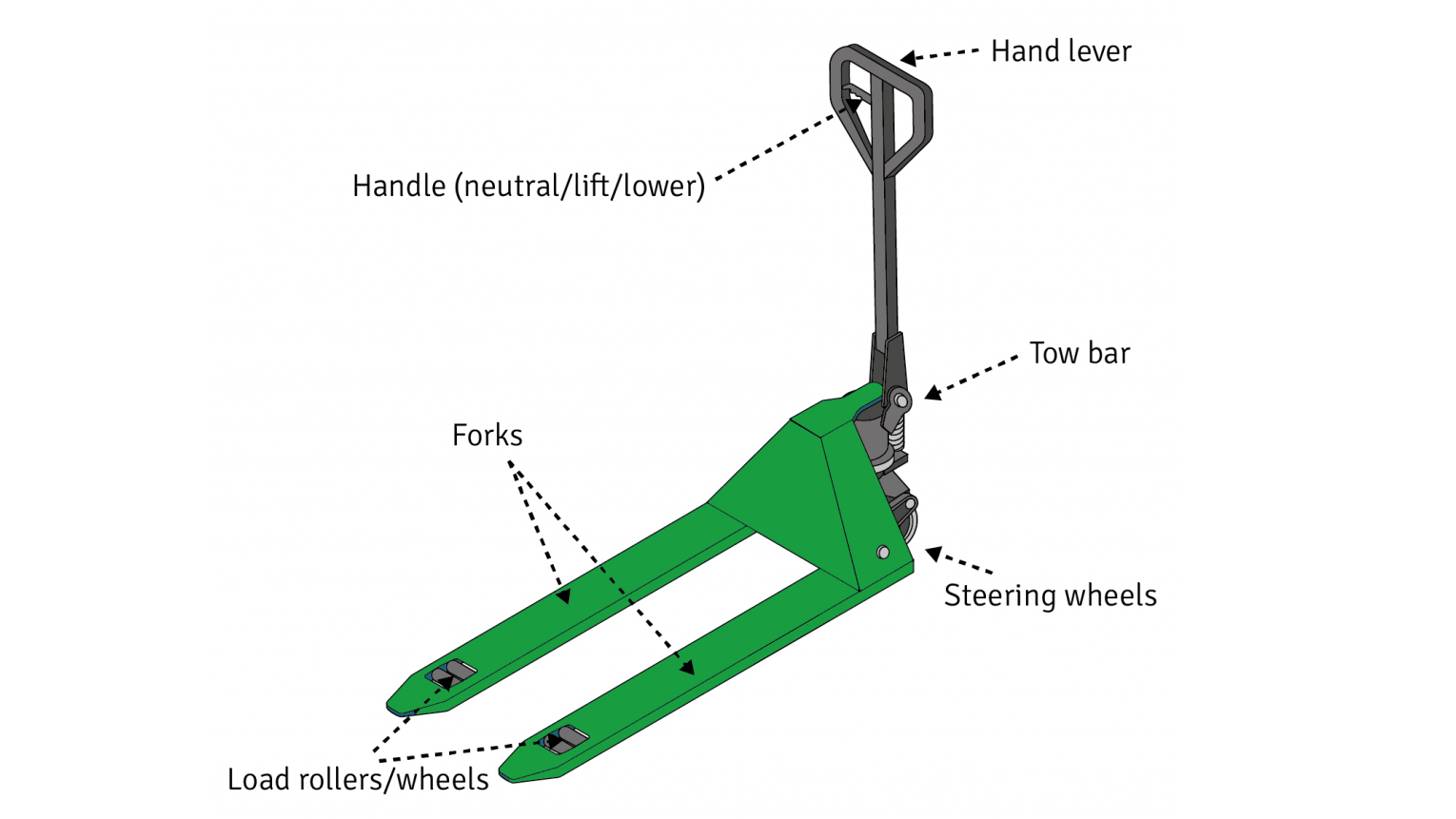
    Pallet trucks, or pallet jacks or pump trucks, are essential in logistics and material handling. These versatile devices are designed to efficiently move palletized loads within warehouses, distribution centers, and manufacturing facilities. Pallet trucks typically consist of a set of forks that slide under pallets, a hydraulic pump for lifting, a handle for steering, and wheels for maneuverability. They come in manual and electric variants, with manual pallet trucks relying on human power to operate the hydraulic lift mechanism while a rechargeable battery powers electric ones. Pallet trucks are valued for their ease of use, cost-effectiveness, and ability to navigate confined spaces. They are crucial in loading and unloading goods from lorries, transporting pallets over short distances, and optimizing storage space. Regular maintenance and operator training are essential for ensuring pallet trucks' safe and effective use in various industrial settings.

    Order Pickers

    Order pickers, a specialized forklift, are engineered to pick and deliver materials directly from racking to fulfill orders. These machines are distinct from traditional forklifts, allowing the operator to ascend alongside the load and enabling item selection at various heights. This is especially useful in warehousing environments focused on retrieving individual items rather than full pallets. Designed to operate efficiently in narrow aisles and reach elevations higher than the second level of racking—up to 456 inches—order pickers are ideal for optimizing low-level and high-level order-picking processes. Their utility shines in narrow aisle warehouses, where conventional handling methods like pallet trucks and rolling ladders fall short. This makes order pickers an indispensable tool in modern warehouses and distribution centers, streamlining the order fulfillment process by providing an agile and safe means of accessing and transporting goods from racking to shipping areas.

    Rough Terrain Forklifts

    Rough terrain forklifts are designed specifically for operation in challenging outdoor conditions, distinguishing themselves as the go-to for handling materials across uneven, rugged terrains. These forklifts are robustly built, featuring large flotation tires and all-wheel drive capabilities, which enable seamless navigation across disturbed construction sites, agricultural lands, timber forestry areas, and more. Typically powered by diesel to ensure ample power in demanding environments, rough terrain forklifts have varying specifications to meet diverse operational needs. These include engine power up to 74 hp, lift heights ranging from 15 to 22 feet, and lift capacities between 6,000 to 8,000 lbs. This makes them not only ideal for construction sites but also for any business requiring the transportation of materials over rough terrains. Their engineering is focused on maximizing efficiency and safety in outdoor settings where conventional forklifts might falter, ensuring that even the most challenging terrains can be tackled confidently and reliably.


    Electric Forklifts:

    • Advantages:
    • Produce zero emissions, making them environmentally friendly and safe for indoor use.
    • Lower maintenance costs due to fewer moving parts compared to internal combustion engines.
    • Quiet operation with minimal noise levels, suitable for indoor environments.
    • Superior maneuverability and compact construction allow easy navigation in tight spaces.
    • Disadvantages: 
    • Higher initial cost compared to internal combustion forklifts.
    • Limited availability for heavy lifting applications over 15,000 lbs.
    • Additional storage space is required for batteries and charging stations.
    • Challenging to use outdoors, especially in wet conditions.

     Internal Combustion Forklifts:

    •  Advantages:
    • Lower initial cost, making them more accessible for purchase.
    • Suitable for heavy-duty applications with high load capacities and performance.
    • Quick refueling capability, allowing continuous operation without extended downtime.
    • It is ideal for outdoor use with rugged construction for harsh environments.
    • Disadvantages:
    • Emissions produced, restricting indoor use due to carbon monoxide emissions.
    • Higher maintenance costs and more parts to repair and replace.
    • Higher fuel costs that can vary, impacting operational expenses.
    Type
    NET WEIGHT
    Max Lift
    Max Height
    Scenes
    Pallet Jack
    70KG
    2T
    200MM
    Warehouse
    Electric Pallet Truck
    200KG
    3T-3.5T
    200MM
    Warehouse/Open Air
    Diesel Forklift
    4000KG-5300KG
    2T-5T
    6000MM
    Warehouse/Open Air
    Off-road Diesel Forklift
    4580KG-7380KG
    3T-5T
    6000MM
    Open Air
    Articulated forklift
    5000KG-8000KG
    2T-5T
    6000MM
    Out door
    Electric forklift
    3050KG-6000KG
    2T-5T
    6000MM
    Warehouse/Open Air
    Order Pickers
    500KG-700KG
    300KG-400KG
    3000MM
    Warehouse
    Heavy Lift
    25000KG
    18T
    5000MM
    Port et
    Side Lift Rider
    6000KG 3T
    3000MM
    Narrow Aisle

    Final thoughts:

    Electric forklifts are known for their zero emissions, making them suitable for indoor use and environmentally conscious operations. They operate quietly and have lower operating costs over time. Internal combustion forklifts, on the other hand, are powerful and ideal for outdoor use, capable of handling rough terrain and heavier loads but have higher fuel costs. Manual pallet jacks are simple, cost-effective tools for moving lighter loads over short distances, requiring manual operation without the need for fuel or charging, making them readily available and easy to maintain across various industries. Product availability varies widely, with electric and internal combustion forklifts being more common in industrial settings, and manual pallet jacks available for a broad range of applications from retail to warehousing.
    Release time: 2024-03-15

    5 Essential Tips for Maximizing Efficiency and Safety with Forklift Trucks

    Related blog
    2025-08-20 |Peter
    Operating Instructions and Safety Precautions for Hand Pallet Truck
    2025-08-20 |Potter
    Operating Instructions and Safety Precautions for Stacker
    2024-06-08 |Jimi Wang
    How to Set Up a Forklift Maintenance Schedule: A Comprehensive Guide
    2024-06-05 |Jimi Wang
    How to use a pallet jack correctly

    PRODUCT

    NEWS

    ABOUT US

    DOWNLOAD

    Subscribe
    SiteMap

    Copyright 2022,All Rights Reserved.

    (380890)
    0